02 ——
The Craft
Content Strategy
Content without strategy is just publishing. Research comes first — understanding what your audience is actually asking, where your expertise genuinely answers it, and how to build something that earns its position rather than occupying it temporarily.
Content strategy is the discipline of deciding what to say, to whom, in what form, and in what order — before anyone writes a word. It's research-led planning that maps your expertise against what your audience is searching for, identifies the gaps and builds a structure that compounds over time.
Done properly it's the difference between a site that appears because it's useful and a site that publishes because it has a content calendar. Volume without intent is noise. The work is finding the intersection of what you know and what people need to know — and building the content that sits there.
Everything starts with data. GSC shows what's already appearing and where clicks are being lost. GA4 shows what content converts and what doesn't. SEMrush and Ahrefs give a view of the wider competitive landscape — what competitors are doing, where the gaps are, and where the real opportunity sits. The strategy is built on that, not assumptions.
Intent distribution also varies significantly by platform. The chart below shows how search intent differs between Google and ChatGPT — transactional queries dominate on ChatGPT in a way they don't on Google. Understanding not just what people are searching for, but where they're searching and what mode they're in when they do, shapes the entire content strategy.
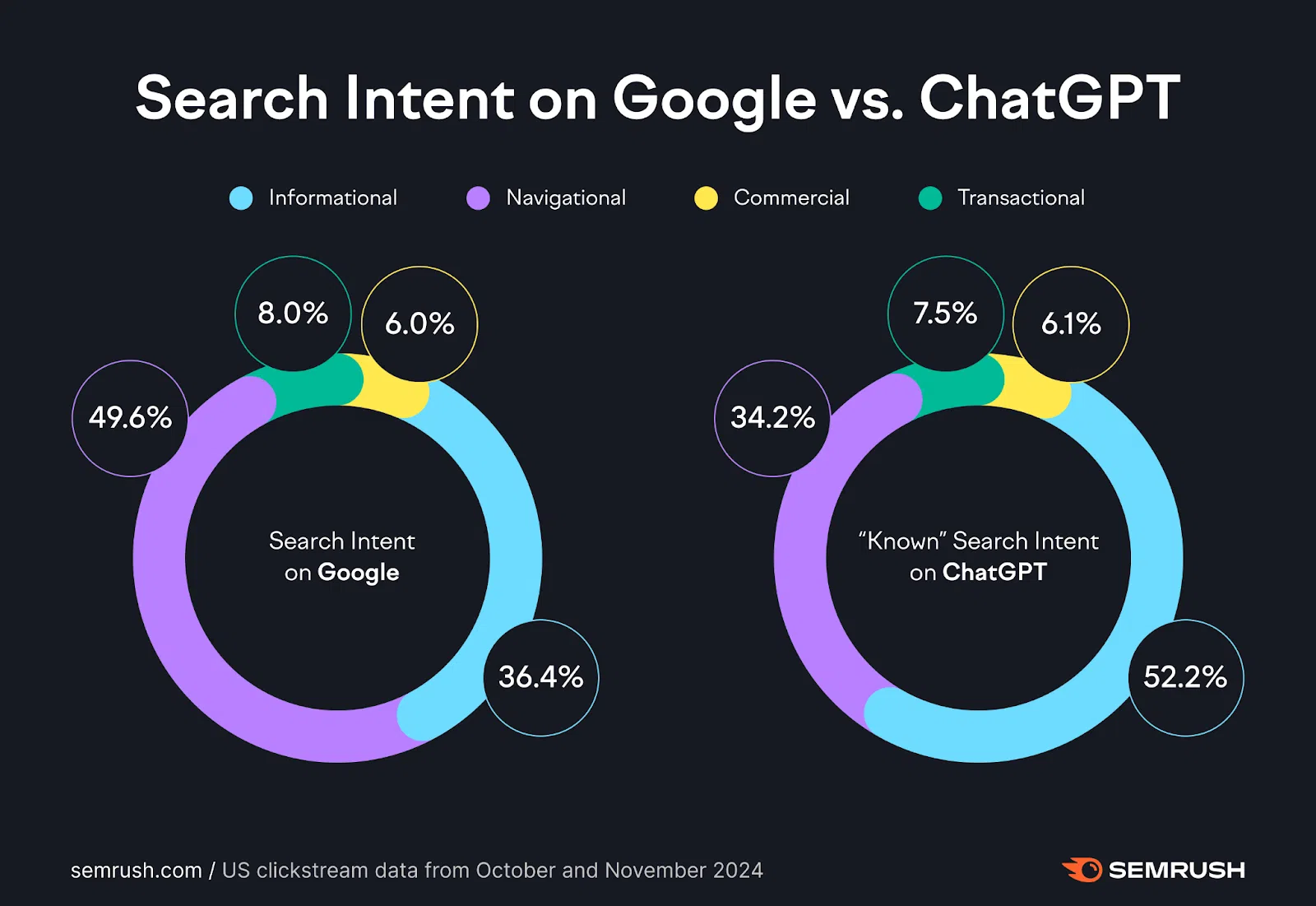
Source: SEMrush — US clickstream data, October & November 2024
The work covers the full content strategy cycle — from initial research through to structure, optimisation and ongoing development. This list isn't exhaustive; every site presents different content challenges and the approach is shaped accordingly.
Understanding what your audience is actually searching for — informational, navigational, commercial, transactional — and mapping content to match the right intent at the right stage. Built from GSC query data, SEMrush and SERP analysis rather than volume figures alone.
What a site actually talks about — mapped as a connected graph of topics and entities, built out into pillar pages and supporting clusters, then proven with the internal links and anchor text that show search engines and AI crawlers how it all connects. Built using the S.V.G.C.S methodology (Semantic Vector Generation and Compliance System). Done properly, it means the site provides the answer before the question's even been thought of.
A systematic review of what's on the site against what should be — GSC and GA4 data showing what's performing, what's thin, what's cannibalising other pages, and competitor analysis showing where there's genuine search demand nobody's answering well yet. Two sides of the same question, run together.
Title tags, meta descriptions, heading structure, body copy, image alt text — the detail work that makes a well-written page a well-appearing one. Applied consistently across priority pages, informed by what GSC shows is underperforming.
Experience, Expertise, Authoritativeness, Trustworthiness — building the signals that establish genuine credibility. Author pages, credentials, first-hand content and editorial standards that demonstrate real expertise rather than performing it.
What to publish and why — tied to search opportunity and GA4 performance data rather than the desire to look active. Priority-driven rather than frequency-driven. The difference between a content plan and a content calendar.
Intent distribution also differs significantly depending on where people are searching. Understanding that mix — and how it's shifting as AI search grows — is central to building a content strategy that works across platforms, not just Google.
Literature covers strategy, planning and optimisation — not copywriting or content production. The deliverable is the framework, the brief and the direction: what to write, why and how it should be structured. The writing itself sits with whoever produces your content.
That said, briefs are written to be used rather than filed — specific enough that a writer can produce the right content from them, with the SEO intent already built in.
Essays on literature, language and what either of them have to do with how search actually works.
Start with what you're currently publishing and what it's achieving. We'll work out where the gap is from there.